
How Much Does a Small Business Website Cost in 2026?
What a small business website costs to build and run each month, what drives the price, and what a clear quote covers.
Updated November 12, 2026
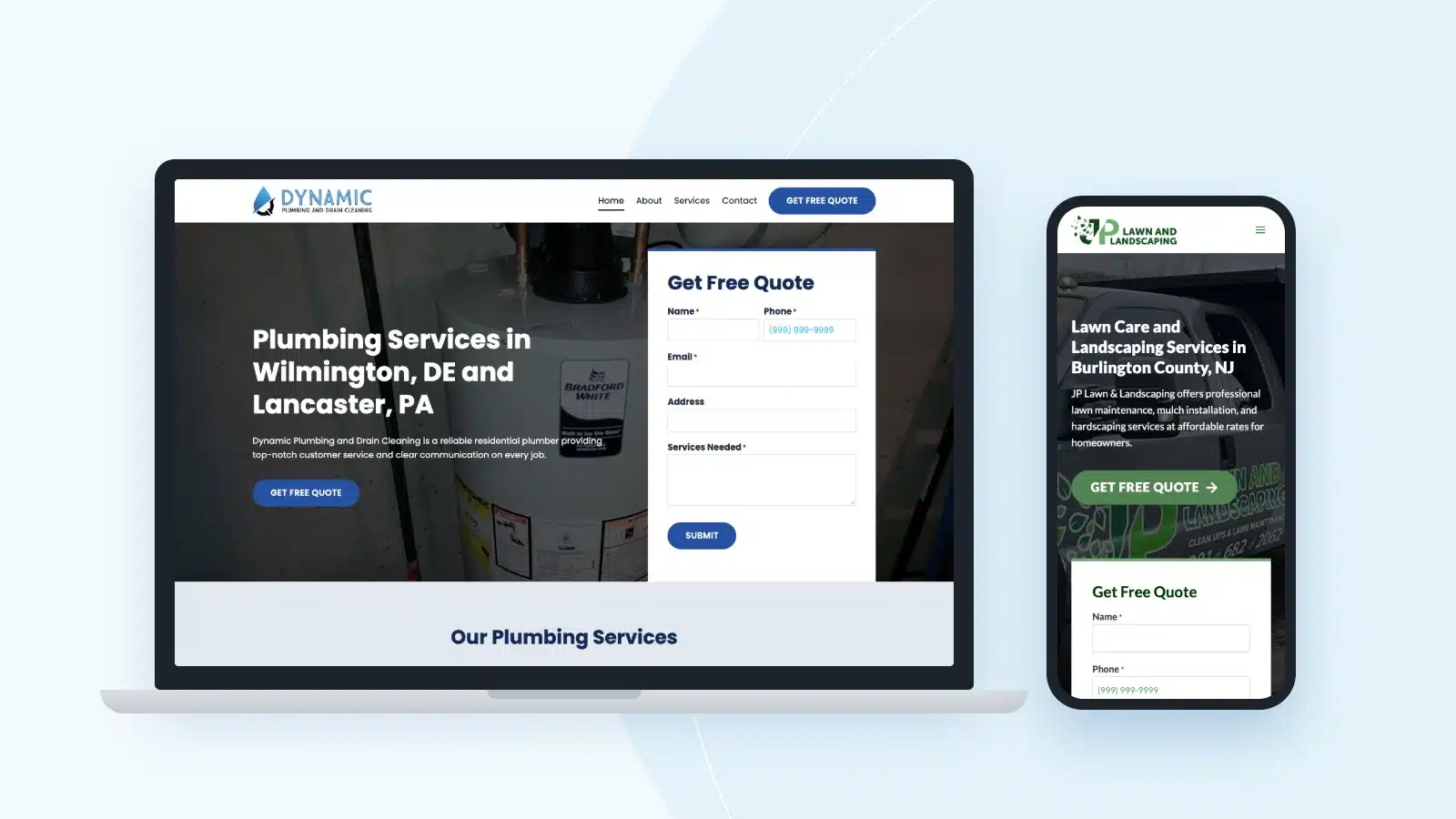
If you’ve looked into getting a website for your business, you’ve probably seen prices everywhere from a few hundred dollars to $10,000 and up. That makes it hard to know what you actually need, or what you should expect to pay.
For most local service businesses, the answer comes down to three things: how much of the work you want to handle yourself, how many pages you need, and who will take care of the website after it launches. Here’s a straightforward look at what each option costs, upfront and every month, from people who build websites for plumbers, landscapers, electricians, and other service businesses.
Website Costs at a Glance: Upfront and Monthly
Typical ranges: $0 to about $450 to build it yourself, $2,000 to $8,000 with a freelancer, or $8,000 to $25,000 or more with a design agency, plus roughly $10 to $420 a month to keep it running.
| Option | Typical upfront cost | Ongoing cost | Best for |
|---|---|---|---|
| Build it yourself on a website builder | $0 to about $450 | About $10 to $21 a month or more, plus a domain at $10 to $35 a year | New businesses with more time than budget |
| Hire a freelancer | $2,000 to $8,000 | $50 to $200 a month | Businesses that want professional help with a smaller project |
| Hire a design agency | $8,000 to $25,000 or more | About $85 to $420 a month ($1,000 to $5,000 a year) | Businesses with larger or more custom website needs |
When you compare options, look at the first year, not just the build. A $2,000 site with $150 a month in upkeep costs $3,800 in its first year. A builder plan at $20 a month costs $240, plus your time.
What It Costs Each Month to Host and Maintain a Website
The upfront price is the cost to build. The monthly fee is the cost to host and maintain it, so it stays online and keeps working. Here’s what that usually covers:
- Hosting, security, updates, and backups. These keep your website online, protected, and up to date.
- Your domain. The address people type in, like yourbusiness.com. It renews every year, and it should be registered in your name.
- Website changes. Find out whether updating your services, photos, hours, or prices is included or costs extra. It’s the part you’ll use most, and it’s where plans differ the most.
- Business email. An address at your own domain, like [email protected]. Forbes Advisor puts entry-level plans at about $1 to $26 per user per month, and some website plans include it.
Two plans with the same monthly price can cover very different things, so ask what’s included before you compare.
Website Costs That Aren’t Always Included
Some costs don’t show up in the first quote or the builder’s monthly price. Here’s what to ask about:
- Website copy. Someone has to write the headlines, service descriptions, and the lines that tell people how to reach you. Ask whether that’s included or whether you’ll need to write it yourself.
- Photos. Photos of your own work are the best kind, and they cost nothing. Stock photos or a photographer cost extra.
- A logo. Many website packages build around the logo you already have. If you don’t have one, that’s usually a separate project.
- Legal pages. If your site collects names or phone numbers through a form, you’ll generally need a privacy policy (some state laws, like California’s, require one). Some plans include it.
- Changes down the road. Adding a new service page or a new town next year may be included in your plan or billed separately.
Why Website Quotes Vary So Much
A $1,000 website and a $6,000 website might both say “5-page business website” on the quote, but that doesn’t mean you’re getting the same thing. Here’s where the difference usually comes from:
- Number of pages. One page costs less than a separate page for each service, each town you serve, and your past projects.
- Who writes the words. If you write your own service descriptions, the price is lower. If the designer writes them, that’s real work, and it’s priced in.
- Special features. Online booking, payments, or a connection to your scheduling software take extra time to set up.
- Rounds of changes. One round of revisions costs less than unlimited back-and-forth.
- What happens after launch. Some quotes include ongoing care and some end on launch day. Add up the build price and a year or two of upkeep, not just the build.
Building It Yourself or Hiring Someone
Building it yourself can be a perfectly good place to start when money is tight and you have time to work on it. Website builders like Wix and Squarespace can cover the basics, and newer AI builders can put a first draft together quickly, though you still write the words, check every detail, and keep it current.
Once your business gets busier, your time is often worth more than the savings. Hiring someone makes sense when your schedule is full, you offer several services or work in several towns, or you’d rather not think about upkeep at all. A freelancer is often one person and can cost less. An agency usually has a set process and offers ongoing plans. Either way, ask who will make changes after launch, and how quickly.
What a Local Service Business Website Actually Needs
Whether you’re a plumber, electrician, landscaper, HVAC company, painter, or another local service business, you don’t need dozens of pages to start. You need a site that clearly shows what you do, where you work, and how to reach you:
- A clear way to call or ask for a quote, with your phone number at the top and set up so people can tap it to call.
- A page for each main service, so someone looking for drain cleaning lands on drain cleaning, not a general list.
- The towns and areas you serve, named on the site.
- Your Google reviews, so people can see what past customers say.
- Photos of your real work, not stock photos of someone else’s.
- Details people check before they call, like your license, insurance, and how long you’ve been in business.
- A simple form to ask for a quote or a callback.
- A layout that works on a phone, since that’s where many people will see it.
- A basic setup for search: clear page titles and descriptions, and your business name, address, and phone number matching your Google Business Profile.
A good local business website isn’t only there to look professional. It should also make it easy for customers, Google, and AI-powered search tools to understand what you do and where you work.
One tip no matter who builds it: make sure the domain is registered in your name, so the address stays yours if you ever change who manages the site.
What a Clear Website Quote Spells Out
A clear quote answers a few things up front, which makes two quotes easy to compare:
- What’s included in the build: how many pages, who writes the words, how many rounds of changes, and when it goes live.
- What the monthly fee covers: hosting, domain, security, backups, and whether changes are included.
- Who owns what: whose name the domain is in, and whether the site is yours.
- What happens if you move on: whether you can take the site with you, and whether there’s a contract or a cancellation fee.
What Does a Website Cost With Boost Web Studio?
We built our website packages around what small local service businesses usually need, without making every business pay for a large custom website. That’s why our prices sit below a typical agency range. Many service businesses don’t need complicated features. They need a professional site that clearly explains what they do, where they work, and how to reach them. Each package is built with the basics for search and makes it easy for potential customers to call or contact you.
- Launch Page: $399, plus $49 a month. A one-page website for a business that needs a simple place to show what it does, where it works, reviews, and how to get in touch. About $987 for the first year.
- Growth Website: $2,000, plus $69 a month. Up to 10 pages, giving your main services their own pages and a stronger foundation for search. About $2,828 for the first year.
- Custom Website: from $5,000, plus $69 a month. For businesses that need a larger site, custom functionality, or something beyond our standard packages.
Every monthly plan covers your domain, registered in your name, plus hosting, security, updates, backups, and a monthly report, so there’s no separate hosting or domain bill. You can see what each Boost package includes.
Not sure how your current website and Google presence are doing? Run our free Google checkup to see how your business shows up online.
Frequently Asked Questions
Is $1,500 a good price for a website?
It can be. It’s below the typical freelancer range of $2,000 to $8,000, so check how many pages it covers, whether you supply the words and photos, and what it costs each month after launch.
What’s the cheapest way to get a website for a small business?
Building it yourself on a website builder, often about $10 to $21 a month plus a domain. The trade-off is your time: you write it, set it up, and keep it current.
How much does a website cost per month?
About $10 to $21 a month or more on a website builder. Ongoing care from a freelancer often runs $50 to $200 a month, and from an agency $1,000 to $5,000 a year, depending on what’s included. The domain is usually a separate yearly cost unless your plan covers it.
How long does it take to build a small business website?
A one-page site can be ready in about a week. A site with several pages often takes a few weeks, depending on how quickly you can send your photos and details.
Is a website worth it for a small business?
For most local service businesses, the website works alongside Google, referrals, social media, and word of mouth. It gives potential customers one place to check you out before they call. A clear site with a page for each service can help more people find you and make it easier for them to call or ask for a quote.
Do I need a website if I have a Google Business Profile?
They do different jobs. Your Google Business Profile shows your hours, reviews, and photos in Google Search and Maps. Your website gives each service its own page, room to explain what you do, and a place for your profile’s website button to point to. Many businesses use both.
Can I just use my Facebook page instead of a website?
A Facebook page is free and worth having. The difference is control: Facebook decides how your page looks, and some people don’t use Facebook at all. A website is yours, built around your services, and anyone can open it. Here’s more on whether you need a website if you already have social media pages.


